

Resilience
The tech is the easy part. It's 350 people each forming their own relationship with it.
Senior leaders shaping the future of hospitality, on the decisions, pressures and people behind the numbers.

The Introduction
Sprout & Co has nearly doubled in size in eighteen months, from around 150 team members to 350. David McCarroll leads technology for the Dublin group, and he has spent that period pulling out legacy systems and rebuilding the stack from the ground up, while trying to make sure a business built on genuine human interaction still feels like one at twice the headcount.
He talks to us about change management at scale, why he can no longer sign a twenty-four-month contract, and the six words that reset his perspective on a bad Saturday night.
What is Sprout & Co?
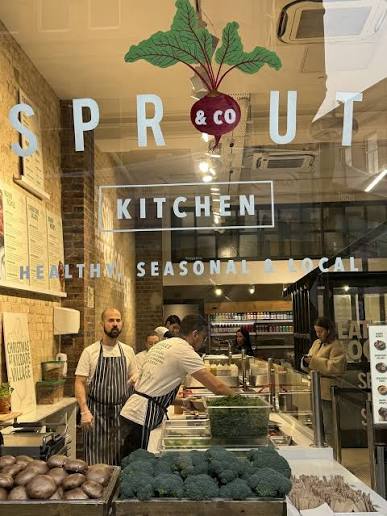
A Dublin group built on healthy, seasonal, local food, grain bowls, salads and soups made fresh, with produce grown on the founders' own family farm in Kildare and delivered into the restaurants.
It was founded by brothers Jack and Theo Kirwan, who grew the idea from a single site into a group of restaurants across the city, farm to counter, with the supply chain kept as close to home as they can.

The Interview
David McCarroll · Twelve QuestionsWas there a moment you knew hospitality was the career, not just the job?
I would love to give you a defining moment, but there wasn't one. What there was, and still is, is the buzz. The noise, the energy, the go-go-go of it. I'm addicted to it, and I mean that fairly literally. Even now, when I get the chance to be back in a restaurant on a lunch rush, I find it hard to leave the place. That isn't nostalgia. It's the most useful hour of my month. It's why our entire support team goes out into the restaurants once a month and works a lunch rush, every single one of us, no exceptions. You learn things standing behind a till that you will never learn from a dashboard. If you're going to make decisions about how somebody's shift runs, you should have to live inside that shift occasionally. That's the closest thing I have to a leadership philosophy.
What's been the single hardest leadership challenge you've faced, the part the outside world doesn't see?
Change management, and specifically what happens to it when you scale. We've gone from roughly 150 team members to 350 in the space of twelve to eighteen months. Rolling out a new system across 150 people is one job. At 350 it is a completely different job, and I underestimated that. Everybody learns differently. And no matter how carefully you design a rollout, however good the training is, however clean the process looks on paper, people will use the system in ways you never imagined they would. Not wrongly, necessarily. Just differently. That's been the lesson of this year for me. The tech is the easy part. The tech nearly always works. It's 350 people each forming their own relationship with it that you have to plan for, and most implementation plans make no allowance for that whatsoever.
“The tech is the easy part. The tech nearly always works.”
Recruitment and retention have been called a crisis for a decade. What have you done differently at Sprout?
About eighteen months ago we sat down and admitted we were not going to get from 150 people to 350 on what we had. So we rebuilt it: a proper ATS for recruitment, an LMS and onboarding platform, and a workforce management system that teams would actually find easy to use. Three implementations in eighteen months, which I wouldn't universally recommend as an experience, but retention is noticeably stronger for it. The part that mattered most was onboarding. There is nothing worse than joining a new company and being thrown straight into the deep end without the information you need. You spend your first fortnight feeling stupid, and a proportion of people quietly decide it isn't for them. First impressions cut both ways. Get somebody's first two weeks right and almost everything downstream of it gets easier. Get it wrong and you're recruiting for the same role again in five weeks' time.
Margins are under relentless pressure, and the answer usually lands back on tech and data. What's genuinely moved the needle?
Visibility. We've just onboarded a new recipe management and inventory platform, and the difference is that we can now see what we're spending, where we're spending it, and where prices are moving, up and down, week to week. Our finance team can look at the business properly for the first time. The frustration before wasn't that we had no data. We had plenty of it. It was buried somewhere in a legacy system and it took a person and half a day to dig out, by which point the decision had usually made itself. Purchasing and inventory data available on demand sounds deeply unglamorous. It's the biggest single step change we've made on margin, because it turns arguments into facts.
So where do you refuse to cut, and where have you learned that you can?
Food quality. We're Sprout, the entire proposition is what's in the bowl, so that simply isn't a conversation we have. Tech is the opposite. Everything is on the table there now. I'm about to run a full assessment of the whole stack over the next few weeks and I fully expect to find duplication. Two years ago these tools stayed in their lanes. Now, with where AI has got to, half of them have quietly grown into each other's territory, and you can end up paying three subscriptions to do one job without ever consciously deciding to. So the honest answer is: don't touch the food, audit the software. Regularly. Nobody else is going to ring you up and mention that you're paying for the same thing twice.
How do you decide which technology is worth the investment and which is just noise?
It sounds like a cliché, but the answer is partners, not vendors. We spent eighteen months rebuilding the stack because we'd inherited legacy systems that weren't user-friendly and made data almost impossible to extract. Somewhere in that process it became obvious that a monthly subscription and a partnership are two entirely different products. We want suppliers who will grow with us, and we're prepared to be useful to them in return. Once you know what kind of company you want on the other end of the phone, the search gets dramatically easier, you're filtering on behaviour rather than features. Contract length has become part of that test, too. When somebody puts twenty-four months in front of us now, we can't sign it. Not won't, can't. The market is moving quickly enough that nobody can honestly tell you what they'll need in two years' time, and the supplier who understands that is usually the one worth working with.
“When somebody puts twenty-four months in front of us now, we can't sign it. Not won't, can't.”


Culture is easy to talk about and hard to scale, and you're scaling fast. How do you keep it consistent across sites and shifts you're never in?
We talk about scaling with intimacy, which is a tidy phrase for something extremely hard to do. The mechanism, for us, is the general managers. We want them to be the most important people in the business, and a large part of my job is simply making their day easier, taking the admin off them so they can spend their time with their team and their guests rather than building an Excel sheet of last week's sales. Nobody joined this industry to spend a Monday morning doing stock take. Every hour you hand back to a GM is an hour they spend on the floor, and the floor is where the culture actually lives. You can't send culture out in a company-wide email. What you can do is give the people who carry it enough time to carry it properly.
“You can't send culture out in a company-wide email.”
When the data says one thing and your instinct says another, which wins?
Our problem isn't a shortage of data, it's the opposite. There is far more data available than you need to run a restaurant, and the real work now is deciding which of it actually matters to us. We are very much still doing that work. Some of it you can't ignore: guest feedback, obviously. You don't get to argue with guest feedback. Beyond that, honestly, you go with your gut a good deal of the time, and I'd rather say so than pretend to a rigour we haven't got yet. It's worked so far, so who's to say it won't work for the next twenty or thirty restaurants. The trap, I think, is using the numbers to justify a decision you'd already made, or to avoid making one at all. I'd take a strong instinct and three numbers that matter over a perfect report nobody acts on.
What's a decision you made under real uncertainty that you're still proud of, even if it was unpopular at the time?
Moving off an all-in-one stack to best in class. We certainly didn't have everyone on board for that, and I don't entirely blame them, the clarity probably wasn't there for everybody at the time, and from the outside it looked like an enormous amount of disruption to replace something that was, technically, working. But we knew where we wanted to take the company. We wanted to be genuinely good at loyalty, at our app, at throughput through the door, and you don't get to be genuinely good at any of those on a platform that treats them as side features. So we powered on through it. I'd make the same call again tomorrow. The thing I'd do differently is spend more time explaining why before we started, instead of proving it afterwards.
What keeps you up at night about the next eighteen months?
AI, and the fact that nobody can honestly tell you where it's going. How do we use it, how do we get the most out of it, how do we use it to be genuinely better at what we do rather than simply faster. That's the interesting part and the stressful part, and they happen to be the same part. What's coming round the corner is very hard to predict, things we're working with now didn't exist a few months ago, which is a strange basis on which to plan anything. The optimism sits in exactly the same place. If you're a business that's willing to move, this is the best possible environment to be in. If you're not, it's frightening. I'd rather be in the first group.
If you could change one thing about how hospitality is built and led, what would it be?
Awareness of what's actually possible in this industry. Hospitality is wonderfully easy to get into, that's one of its great virtues, but there's a barrier when it comes to moving from the restaurants into a support team, and I don't think enough people can see a route through it. I was lucky. I got to stay, and join the support team here. But a lot of careers hit a ceiling, and it isn't because the roles don't exist. It's because nobody ever mentions them. Ten years ago I had no idea I'd end up leading technology for a restaurant group. I didn't know the job was a job. We are not very good at telling people that tech, finance, marketing, property, people, all of it, is available to them without ever leaving the industry. Fixing that would change a great deal, and it wouldn't cost anybody a penny.
“Ten years ago I didn't know the job was a job.”
Five years out, what does great hospitality look like?
Genuine interaction. There's endless talk about robots and AI and automation, and none of it beats a real conversation with another human being, and I think that becomes more valuable every year, not less. The human behind an email will become a sought-after thing rather than an assumed one. Scarcity does that. So the businesses that win in five years won't be the ones that automated the most. They'll be the ones that automated the right things and then spent the time they got back on people. That genuine touch, and being generous with it. That's it, really.

Everyone works a lunch rush
Once a month the entire support team goes out into the restaurants, every single one of them, no exceptions. You learn things standing behind a till that you will never learn from a dashboard.
The Quickfire Round
First instinct only. No diplomatic answers.Leadership is built on the connections you can rely on.
Sky Business is the B2B division of Sky, one of Europe's leading media and entertainment companies and part of Comcast Corporation. Sky provide reliable connectivity solutions and unmissable live sport and entertainment to businesses of all sizes and sectors.
Resilience is a Stacked series, in partnership with Sky Business, monthly conversations with the leaders keeping hospitality standing.
Discover Sky Business →